Abophil
Online Stamp Journal

English translations
Online Stamp Journal
6.4.2026
Inverted date discovered in Turku censor mark
By Martti VihantoAn AI aided translation of Turun sensuurileimasta löytynyt ylösalainen päiväys.
Postal censorship in Finland was extended in the summer of 1914 when Russia entered the war, and Finland, as part of the Russian Empire, was placed under wartime conditions. One of the censorship offices operated in Turku. Over time, 15 different censor marks were used there. Only quite recently, a previously unrecorded subtype has been discovered.
The Danish collector Jon Iversen has studied postal censorship of the years 1914–1918 and compiled the findings on the website Russian Postal Censorship in Finland. A detailed catalogue of censor marks, approximately 500 pages in length, may be found under the menu item contents. The site can be freely accessed and downloaded. An introduction was presented in the March 2024 issue of Abophil.
The Turku censorship office’s censor mark no. 10 is oval in form. Iversen sent to the editor of Abophil an image of a postcard he had found, on which the date of the mark appears upside down. This is, thus far, the only known example of its kind. The card travelled in November 1916.
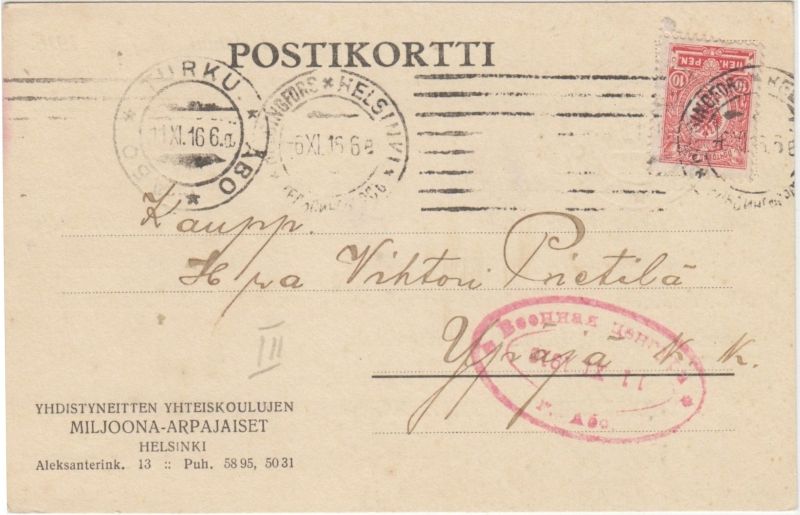
The postcard was sent from Helsinki to Ypäjä, which belonged to the Turku postal censorship district. The Turku machine cancellation is without lines, and the date in the Turku censor mark, 11 November 1916, is inverted. From the collection of Jon Iversen.
Two types of the Turku oval censor mark are known, both of them quite common. They may be distinguished by the position of the rosette on the right-hand side. The newly discovered item belongs to Type 2.
The known period of use for Type 2 extends from 16 August 1916 to 27 October 1917. On the censorship website there is an image of a registered letter sent from Petrograd (St Petersburg) to Turku, bearing a censor mark dated 27 October, the latest known date of use. By this time the stamp was already heavily worn.
A bulletin of the Postal Administration, dated 26.11.1917, states that the censorship office of Turku is closed. The physical location of the office is not known.
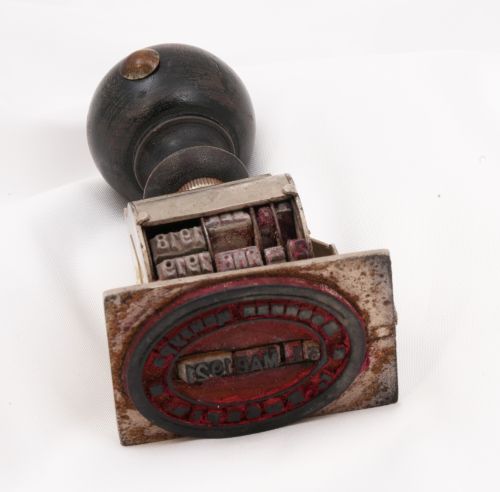
The stamp of the oval censor mark of Viipuri, from the collections of the Finnish Postal Museum. The number wheels used for changing the date are visible in the image.The date is accidental.
Oval censor marks were used in all ten censorship offices. With the exception of Tornio, an inverted date is now known of them all. In the marks of Tampere and Viipuri, this subtype appears relatively frequently.
The digital publication format of postal censorship research makes it possible to add new observations and update information. Iversen gladly welcomes new data and other feedback. Contact details are on his website. #98
15.3.2024
An extensive online catalogue of postal censorship 1914–18
By Martti VihantoA computer aided translation of Postisensuurista 1914–18 laaja online-luettelo.
Censorship of postal items was expanded in Finland when, in the summer of 1914, Russia joined the war, and Finland, as part of Russia, entered in a state of war. Finland declared its independence in late 1917, but Russian censorship regulations were applied to some extent even after that. There was similar delay, for example, in postage rates.
Among others, Juhani Olamo, Hans G. Moxter, Teuvo Termonen, Jorma Keturi and Roger P. Quinby have studied and published on postal censorship of the period 1914–18. Jon Iversen from Denmark has continued the research and recently published its results on the website censor.jiv.dk.The basis is Quinby's CD from 2017. The news is announced in the latest issue of Filatelisti 2/2024. The magazine can be read on the member site of the Philatelic Federation of Finland.
Iversen has written about Finnish philately before. We can mention the Postal History from Finland 1889–1918 section on his website as well as Russia in Finland. The Story of Russian Stamps & Postal Stationery Used in Finland, 1899–1918, co-authored with Morten Nårstad and Quinby, and published in 2019. The book is introduced on the website of Turun Postimerkkikerho.
The postal censorship website published by Iversen is titled Russian Postal Censorship in Finland 1914–18. The timeline presented in it helps to follow the events from the outbreak of World War until the Civil War of Finland. Postal censorship during the Civil War is beyond the scope of the website. Other forms of censorship occurred in the period as well.
There were a total of ten censorship offices in different locations. The website lists the censor marks used in each, closing tapes, wax seals, and signatures or initials of the censors. In addition, there is information on dates of use and estimates of rarity on a five-point scale. The problem of mark and other forgeries is excluded.
Wax seals were used in registered and insured items. There are a few covers on the site where the censor tape is sealed on the front side.

The first page of the Turku section in Jon Iversen's censorship catalogue. The links shown in blue make it easier to navigate the site.
There is a 30-page PDF file about Turku, including a lot of postal items with interpretation, such as conclusions about a plausible route. The numbering follows Juhani Olamo's book Postisensuuri Suomessa 1914–17 (Postal Censorship in Finland 1914–17) from 1972. The catalogue adds new information to the book Turun postin historiaa ja postileimoja (Postal history and cancellations of Turku) published by Turun Postimerkkikerho and introduced here.
Clear pictures of censor marks are helpful even for one collecting them only, without going into details of censorship philately. Cross-linking speeds up the use of the site. The files can be downloaded to one's own computer.

A money order sent in April 1916 from Pertteli to Perniö and censored in Turku. Censor mark No. 4, which is fully visible on the item, is a censor’s personal one. Part of the mark is usually on the separable coupon-part in money orders.
In addition to the roughly 500-page catalogue, the website gives the introductory chapter of Olamo's book and Jorma Keturi's article published in Suomen Postimerkkilehti 3/2018 translated into English. The magazine can be read on the website of Suomen Filatelistiseura.
The mail censorship website published by Jon Iversen is comprehensive, high-quality and easy to use. It involves a large amount of information, which is now available to everyone in one place free of charge.
The digital publication format makes it possible, not only to save on printing costs, but also to add new observations and continuously update other contents. Iversen is happy to receive new information and other feedback. #99